Services
Areas
Event Types
How It Works
Book Guards Now → Client Login
Security Guides & FAQs
Pronto Guards
(747) 327-7380
Retail Security & Companies Across California
Statewide Service · California

Book Retail & Loss Prevention Security Online

Licensed officers across California — transparent instant pricing, booked online in about 60 seconds. No contracts, no callbacks.

Licensed & Trained Retail Security & Companies Officers · Serving All of California

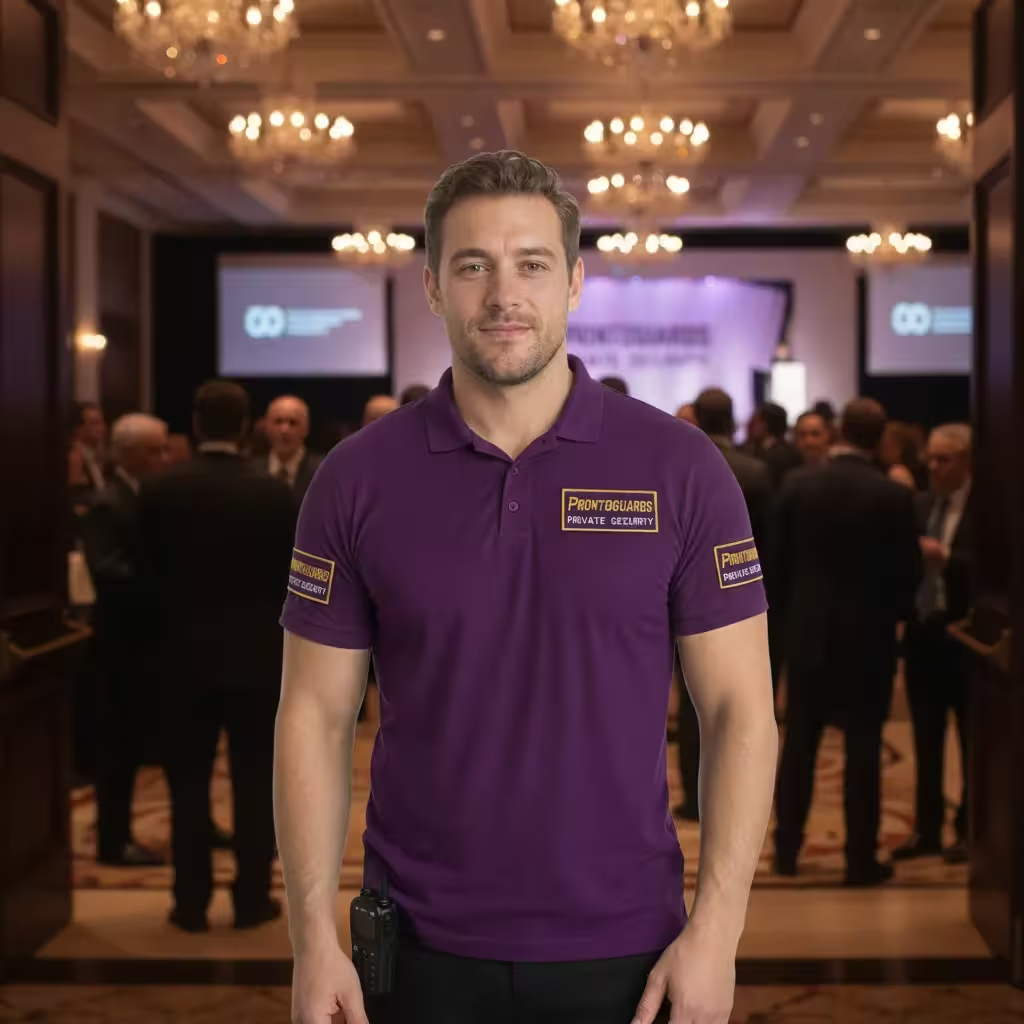
Licensed Retail Security & Companies guards on duty in California

Retail security across California

Retail shrink is not one problem, it is three: external theft, internal theft, and process error — and only the first two respond to an officer on the floor. Pronto Guards is a licensed California security company staffing stores, shopping centers, and retail parks with uniformed officers trained in visible deterrence, incident documentation, and de-escalation. If you are comparing retail security companies, the question worth asking is not how quickly they can send someone but what that person is instructed to do when they see a theft in progress.

600+online bookings
68,000+hours of coverage
435+events covered
24/7dispatch

Retail security: what it actually involves

Presence is the product. Most external theft is opportunistic and decided within the first moments inside a store, which means a uniformed officer positioned where they are actually seen prevents more loss than any amount of recorded footage. The officer’s job is to be visible, not hidden.

The second job is customer safety, and it is larger than most retailers expect. Officers handle disputes between customers, escort staff to their cars after close, manage an intoxicated or unwell person on the floor, and respond first to a slip or a medical incident. That work rarely shows up in a shrink report but it is a real part of the value.

The third job is documentation. An incident with no written record is difficult to prosecute, difficult to claim on, and invisible in the pattern analysis that tells you which hours and which entrances are your actual problem. Officers produce written reports on every incident.

What retail security costs (shown upfront)

Priced per officer, per hour, four-hour minimum. Most stores run a single uniformed officer through peak trading hours, with additional coverage scoped to open, close, and weekend traffic rather than sold as a flat package.

Officer / coverage typeRate (per hour)Best for
Unarmed uniformed officer$40–$60/hrThe standard for retail — entrance and floor presence, customer-safety response, incident documentation, and closing coverage.
Armed officer$60–$90/hrFor high-value inventory, cash-heavy operations, or locations with a documented armed-incident history. Most retail does not need it, and we will say so.
Shopping center patrol$45–$70/hrMarked patrol covering common areas, parking, and multiple tenant frontages on a documented route.

Real examples

Short-notice bookings within 24 hours carry a 10% surcharge, shown before you pay. Recurring daily or weekend coverage is quoted at the block rate. You see the full total online before booking — no quote call.

How we scope a retail account (an operator’s view)

Coverage follows the footprint, the trading pattern, and where loss actually happens. The sequence:

  1. Map entrances and sightlines

    First we establish how many ways in and out exist and where an officer can actually be seen from. A store with two entrances and a blind stockroom corridor is a different problem from a single-door boutique, and the post count follows from that rather than from square footage.

  2. Match hours to the incident pattern

    We ask what your loss and incident history actually looks like by hour and day. Most retailers discover their exposure sits at open, close, and weekend afternoons rather than spread evenly across trading hours.

  3. Agree the intervention policy in writing

    Before the first shift we settle exactly what an officer does when they witness theft — observe and report, approach and deter, or contact law enforcement. This is written into post orders so it is consistent across every officer and every shift.

  4. Assign consistent officers and a supervisor

    The same officers work your store wherever scheduling allows, because familiarity with staff, regulars, and normal patterns is what makes the difference. A named supervisor owns the account and reviews incident reports with management.

What goes wrong in retail security (and how it is prevented)

The officer who becomes furniture

The commonest failure: an officer parked in one spot for eight hours who stops being noticed by staff, customers, and thieves alike. Post orders specify movement — varied floor rounds and repositioning — because a static officer stops deterring within days.

Unclear intervention policy

An officer who physically stops a shoplifter without a written policy behind them creates severe liability for the retailer. We agree observe-and-report or intervention boundaries in writing before the first shift, so nobody is improvising.

Coverage aimed at the wrong hours

Retailers often buy coverage for the busiest hours when their loss concentrates at open, close, and shift change. Coverage should follow the incident pattern, not the foot traffic.

No relationship with store staff

An officer who does not know the team cannot be told quietly that someone is back. Consistent officers who build that rapport catch far more than rotating strangers.

Uniformed officer vs. the alternatives

Retailers generally weigh three approaches to shrink and safety. What each actually delivers:

OptionWhat you getShrink reality
Uniformed security officerVisible deterrence at the door and on the floor, incident response, documentation, and coverage at open and close.Prevents rather than records. Deters the opportunistic theft that makes up the bulk of external shrink.
Plainclothes loss preventionDetection and apprehension of theft in progress by a trained specialist working undetected.Effective against organized and repeat theft, but carries real detention liability and costs more. A complement to uniformed presence, not a replacement.
Cameras and tags aloneA recording and an alarm at the door. Both useful and both entirely passive.Documents what left the store. No deterrent at the decision moment and nobody to respond — which is why loss continues despite full camera coverage.

How to hire retail security: what to look for (and avoid)

Retail is where the security industry competes hardest on price, and where the cheapest option most reliably costs more. What actually matters:

  1. Verify the BSIS PPO license

    Any company providing guards in California must hold a Private Patrol Operator license and deploy Guard-Card officers. Ask any security firm for its PPO number and verify it before signing. Pronto Guards operates under PPO 122150.

  2. Ask what the officer is instructed to do about a theft in progress

    This is the question that separates providers. Most retailers do not want an officer physically detaining shoplifters — the liability is severe. A serious provider will discuss observe-and-report versus intervention policy before you sign, not after an incident.

  3. Ask W-2 or subcontractor

    Retail posts are frequently filled by security contractors passing shifts to whoever is available, which means a different stranger in your store weekly and no relationship with your staff. Ask directly.

  4. Ask about customer-facing training

    A retail officer spends far more time answering questions and de-escalating frustrated customers than confronting theft. An officer with no customer-service instinct damages the shopping experience you are paying to protect.

  5. Confirm insurance in writing

    $1,000,000 per occurrence is the working standard. Retail carries genuine public-liability exposure and a provider who cannot produce a certificate on request is not one to put on your floor.

Where retail security earns its cost

Uniformed floor presence

A visible officer at the entrance and on the sales floor is the single most effective deterrent against opportunistic theft — most of which is a decision made in the first thirty seconds inside the door.

Opening and closing coverage

Open and close are the highest-risk moments in retail: cash is counted, doors are unlocked or unsecured, and staff are alone. Officer coverage removes the exposure.

Shopping center and lot patrol

Officers cover parking areas, common areas, and the exterior — where customer-safety incidents and vehicle break-ins concentrate.

Incident response and documentation

When something happens, an officer manages the situation, contacts law enforcement if warranted, and produces a written report that supports a prosecution or an insurance claim.

A licensed California security company — accountable

  • Licensed California security operator (BSIS PPO)
  • Every officer holds a current BSIS Guard Card
  • Founded 2019 · 600+ bookings · 435+ events covered
  • Transparent online pricing — booked in about 60 seconds
CA BSIS Licensed
Founded2019
CoverageStatewide · 24/7

Book retail security security in four steps

Choose your guards

Pick unarmed, armed, or off-duty officers and set how many you need.

Set the schedule

Add your date, hours, and any extra days. Watch the per-guard, per-hour price update live.

Add the details

Give us the venue or site address and what the job involves so officers arrive ready.

Book & confirm

Pay securely online and get instant confirmation. We assign and brief your officers.

Book retail security security in your city

We run dedicated local teams across California. Book in the city where your event or job is:

Retail Security & Companies FAQs

How much does retail security cost in California?

Retail security runs roughly $40–$60 per hour for an unarmed uniformed officer, with a four-hour minimum. A single store covering an 8-hour trading day is typically around $384. Armed coverage runs higher and is genuinely unnecessary for most retail. You see your exact total online before booking.

Will a security guard stop shoplifters?

That depends on the intervention policy you set, and it should be a deliberate decision rather than an assumption. Many retailers prefer observe-and-report, where the officer documents and contacts law enforcement rather than physically intervening, because detention carries real liability. We agree this in writing before the first shift.

Do I need armed or unarmed retail security?

Unarmed is right for the large majority of retail. Uniformed presence deters opportunistic theft without changing the atmosphere of your store. Armed coverage makes sense for high-value inventory, cash-heavy operations, or a documented armed-incident history at your location.

Can one officer cover a whole shopping center?

Rarely well. One officer can patrol common areas and parking on a documented route, but they cannot simultaneously hold a presence inside multiple tenant frontages. We scope from your actual layout rather than quoting a headcount you would like to hear.

What is the difference between security guards and loss prevention?

A uniformed security officer deters by being visible and handles incidents and customer safety. Loss prevention typically works plainclothes to detect and apprehend theft in progress. They solve different parts of the shrink problem, and most retailers are better served starting with visible uniformed presence.

Does a security guard actually reduce shrink?

Against external theft, yes — visible uniformed presence deters the opportunistic theft that makes up most of it. Against internal theft, partially: an officer changes behaviour at the back door and during close, but employee theft is primarily addressed through process, audit, and supervision. And against process error — mispriced items, receiving mistakes — an officer does nothing at all. Any provider promising an officer will fix all your shrink is selling something.

How quickly can you cover a store?

Same-day and next-day coverage is normal for standard retail posts, and you book it online rather than waiting on a callback. Short-notice bookings within 24 hours carry a 10% surcharge, shown before you pay.
Need retail security security in California?

Book licensed officers online in about 60 seconds — exact price shown before you pay.

Order Guards Now →
Licensed CA security Call (747) 327-7380 24/7 dispatch