Services
Areas
Event Types
How It Works
Book Guards Now → Client Login
Security Guides & FAQs
Pronto Guards
(747) 327-7380
Warehouse Security Guards & Companies Across California
Statewide Service · California

Book Warehouse Security Guards Online

Licensed officers across California — transparent instant pricing, booked online in about 60 seconds. No contracts, no callbacks.

Licensed & Trained Warehouse Security Guards & Companies Officers · Serving All of California

Licensed Warehouse Security Guards & Companies guards on duty in California

Warehouse & distribution security across California

Warehouse loss is not random — it concentrates at the gate and the dock, where inventory moves and people have a legitimate reason to be present. Pronto Guards is a licensed California security company staffing industrial and distribution sites with officers who verify drivers, log inbound and outbound loads, and hold the access points that actually matter. If you are comparing warehouse security companies, the question worth asking is not how many officers they can send but whether those officers are trained to document what leaves the building.

600+online bookings
68,000+hours of coverage
435+events covered
24/7dispatch

Warehouse security in California costs $40–$70 per officer per hour with a four-hour minimum. A 10-hour gate post runs about $480; a 12-hour overnight yard shift about $624; documented overnight patrol rounds start at $45/hr. Officers verify drivers and loads against the schedule, log tractor, trailer, and seal numbers, walk timestamped checkpoints, and escalate to a named supervisor. Pronto Guards scopes coverage to when your loss actually happens and shows the exact total before you book.

Warehouse security: what it actually involves

The gate is the control point. An officer verifies the driver against the scheduled appointment, records the tractor and trailer numbers, checks the seal on inbound freight, and logs the time in and out. Nothing about that is dramatic, and it is the reason organized cargo theft skips staffed facilities for unstaffed ones.

The dock is where internal loss concentrates. Most warehouse shrink is not a break-in — it is product leaving with people who are supposed to be there, during hours when the building is busy. An officer watching loading, verifying that what goes on the trailer matches the manifest, and being visibly present changes the calculation for anyone considering it.

The trailer yard is the overnight exposure. Staged trailers sitting unattended are a standing target, and fence lines get cut in the quiet hours. Documented patrol rounds with timestamped checkpoints cover that window and give you something concrete for an insurer if a claim ever follows.

What warehouse security costs (shown upfront)

Priced per officer, per hour, four-hour minimum. Most distribution sites run a fixed gate post during operating hours plus overnight patrol coverage, and multi-shift facilities are scoped by shift rather than as one continuous block.

Officer / coverage typeRate (per hour)Best for
Unarmed gate or dock officer$40–$60/hrThe standard post — driver and load verification, inbound and outbound logs, trailer yard checks, and visitor control at the main gate.
Armed officer$60–$90/hrFor high-value cargo, electronics and pharmaceutical freight, or sites with a documented theft or armed-incident history. Scoped honestly — most warehouses do not need it.
Overnight patrol coverage$45–$70/hrDocumented rounds of the yard, dock doors, fence line, and trailer staging between shifts, with timestamped checkpoint logs.

Real examples

Short-notice bookings within 24 hours carry a 10% surcharge, shown before you pay. Multi-shift and recurring coverage is quoted at the block rate. You see the full total online before booking — no quote call, no negotiation.

How we scope a warehouse account (an operator’s view)

Coverage is scoped to where product moves and when the building is exposed. The sequence:

  1. Map the access points

    First we establish every way in and out — main gate, dock doors, employee entrance, yard access, fence gaps. That list determines how many posts are genuinely required, which is often fewer than a vendor quoting by headcount will tell you.

  2. Match coverage to shift patterns

    A single-shift operation with a locked overnight has different exposure than a 24-hour facility with continuous trailer movement. Post hours follow your actual freight schedule, not a generic template.

  3. Define what gets documented

    Before the first shift we agree on what the officer records — driver, carrier, tractor and trailer numbers, seal condition, times, visitor log. Written into the post orders so the standard does not drift with personnel.

  4. Assign a supervisor and review the logs

    A named supervisor owns the account, checks that post orders are being followed, and reviews logs with site management. Coverage nobody audits reverts to a chair by the gate within a month.

Which coverage model fits a warehouse?

Coverage modelWhat it stopsOfficers and cost
Day gate postUnscheduled trucks, unverified drivers, loads leaving without a recordOne officer per gate per shift; a 10-hour post is about $480.
Dock coverage during loadingInternal shrink — product leaving with people who are supposed to be thereOne officer on the dock through peak loading; often the highest-return post on the site.
Overnight static postTrailer-yard theft, fence cuts, break-ins when the building is emptyOne officer, 12-hour overnight, about $624; scaled to two for large yards.
Overnight patrol roundsThe same overnight exposure, at lower cost, on sites with lower value stagedTimestamped checkpoint rounds from $45/hr; a documented presence rather than a continuous one.
Combined 24/7Everything above, across continuous trailer movementGate plus dock by day, static or patrol by night; a supervisor reviewing logs weekly.
Weekend and holiday onlyThe window when most yards sit unattended for 48–72 hoursOne officer per shift, Friday night through Monday morning.

Match coverage to when your loss actually happens

Most warehouse operators buy night coverage because a break-in is what they imagine. Most warehouse loss walks out at two in the afternoon: an extra pallet on a legitimate truck, a case that never made it from the dock to the rack, a driver who was never on the schedule. The gate and the dock during business hours are where the record is made, and a record is the only thing that lets you find a missing load a week later. Overnight coverage protects the yard; daytime coverage protects the inventory. They are different exposures, and the right answer is usually the one you were not thinking about.

We map every access point, look at your shift pattern and what is staged in the yard, and scope from that. Book-a-Guard shows the count and the total before you commit, and a named supervisor reviews the logs with your site manager.

What changes by facility type

FacilityWhat changesDeployment
Distribution centerHigh trailer volume, scheduled appointments, multiple dock doorsGate post verifying every driver against the schedule; dock coverage through peak loading; yard rounds overnight.
Cold storageFewer doors, higher value per pallet, temperature-controlled loading windowsDock coverage keyed to loading windows; seal checks on every inbound reefer.
Cross-dockFreight on the floor for hours, not days; constant movementA dock officer matching outbound against manifests; gate logging of every tractor and trailer.
E-commerce fulfillmentSmall, high-value items; employee entrances busier than the gateEmployee-entrance and shift-change coverage; a visible presence at packing exits.
ManufacturingRaw material and finished goods, tools, copper and metalsGate control, after-hours static or patrol, checkpoints at material storage.
Flex industrial or self-storageMany tenants, many keys, weak perimeterPatrol rounds with timestamped checkpoints; a presence during move-in and move-out hours.
Cannabis-adjacent logisticsCompliance-driven: licensed access control and documented presenceA standing post scoped to the licensing requirement; officers who treat it as compliance work, not just deterrence.

What goes wrong at distribution sites (and how it is prevented)

The gate officer who logs nothing

The most common failure in industrial security. A post exists, a person sits in it, and no record is produced — so when a load goes missing there is no way to reconstruct who was on site. Our gate officers maintain a written inbound and outbound log you can review.

Rotating strangers on post

An officer who does not know your normal traffic cannot spot the truck that does not belong. Where scheduling allows, the same officers hold your post, because familiarity with the site is the actual skill.

Unwatched loading during business hours

Operators focus security on nights while the majority of shrink walks out at 2 p.m. Coverage is scoped to when your loss actually occurs, which usually means presence during operating hours as well as after.

No escalation path

An officer who finds a cut fence at 3 a.m. and has nobody to call is a liability. Every account has a named supervisor and a documented escalation procedure to site management and, when warranted, law enforcement.

A staffed gate vs. the alternatives

Most warehouse operators are choosing between three approaches. An honest comparison of what each actually delivers:

OptionWhat you getLoss reality
Staffed gate and dock officerA person verifying every driver, load, and departure, with a written log. Deterrence at the exact point where loss happens, plus a record if something goes wrong.Highest cost, and the only option that prevents rather than documents. Pays for itself on a single prevented load.
Overnight patrol onlyDocumented rounds of the yard and dock doors between shifts. Deterrence when the site is empty.Strong value for sites whose loss is after-hours. Does nothing about shrink that walks out during operating hours.
Cameras and access badges aloneA recording and an audit trail. Both useful, neither of which stops a trailer leaving with an extra pallet.Lowest cost. Most warehouse shrink happens in plain sight during business hours, which is precisely what unmonitored systems miss.

How to hire warehouse security: what to look for (and avoid)

Industrial security is a volume business, and volume is where standards slip. These are the questions that separate a real operator from a staffing agency filling a post:

  1. Verify the BSIS PPO license

    Any company providing guards in California must hold a Private Patrol Operator license and deploy Guard-Card officers. Ask any security firm for its PPO number and verify it before signing. Pronto Guards operates under PPO 122150. You can verify any California PPO license yourself on the state’s DCA license search or via the Bureau of Security and Investigative Services.

  2. Ask what actually gets logged

    A gate officer who waves trucks through is decoration. Ask specifically: are driver names, trailer numbers, seal numbers, and times recorded, and can you review those logs? That record is the entire deterrent.

  3. Ask W-2 or subcontractor

    Warehouse posts are commonly filled by security contractors passing the shift to whoever is available, which means a different stranger at your gate weekly and no accountability when inventory goes missing. Ask directly.

  4. Confirm officers are trained for your freight

    Verifying a bill of lading against what is on the trailer is a learned skill. An officer who has never done dock work will not catch a short-load or an extra pallet.

  5. Confirm insurance in writing

    $1,000,000 per occurrence is the working standard. A provider who cannot produce a certificate on request should not be controlling access to your inventory.

Ten questions to ask any warehouse security company

AskThe answer you want
What is your BSIS PPO number?A number you can verify on the state license search before you sign.
What exactly gets logged at the gate?Driver, carrier, tractor and trailer numbers, seal number and condition, time in and out, visitor entries.
Are the officers your employees or subcontractors?Employees, and the same officers on your posts so they know your normal traffic.
Are officers trained to verify freight?Yes — bill of lading against the trailer, seal checks, manifest matching on the dock.
What is the escalation path at 3 a.m.?A named supervisor on a number the officer and your manager both have.
How are patrol rounds documented?Timestamped checkpoints, with the log delivered to you.
How often are logs reviewed with us?Weekly, by the supervisor who owns the account.
Can you provide a certificate of insurance?Yes — $1,000,000 per occurrence, naming the site owner or landlord if required.
Can you cover multiple shifts or 24/7?Yes; coverage is scoped to your shift pattern and yard exposure.
What will it cost, exactly?A per-officer rate and a total you see before you book.

A warehouse shift, hour by hour: what goes wrong and who covers it

Industrial loss follows the clock. Here is where it happens across a shift and which post has it covered.

PhaseWhat goes wrongWho covers it
Pre-shiftLast night’s log unread; a cut fence or open dock door nobody reportedThe officer reads the overnight log and walks the yard before the first truck arrives.
Gate opensUnscheduled drivers, borrowed tractors, wrong trailersThe gate officer verifies each driver against the appointment list and logs tractor, trailer, and seal.
Peak loadingExtra pallets on legitimate trucks; cases that never reach the rackThe dock officer watches loading and matches outbound against the manifest.
Mid-shiftVisitors and contractors wandering; employee-entrance proppedVisitor log at the gate; a walk of the employee entrance and the parking area.
Shift changeThe busiest thirty minutes: two crews, open doors, nobody watching the dockThe officer holds the dock and the employee entrance through the changeover.
LockdownDoors left unsecured, trailers left unsealed in the yardA documented lock check of every dock door and staged trailer.
OvernightFence cuts, trailer-yard theft, trespassStatic post or timestamped patrol rounds; a named supervisor to call at 3 a.m.
Morning hand-off and weekly reviewIncidents that never reach managementThe overnight log is handed to the day officer; the supervisor reviews the week’s logs with the site manager.

What your insurer, your landlord, and your customers’ audits ask for (and what we provide)

Warehouse security is increasingly something you have to prove, not just have. Property and cargo insurers, landlords, and large customers running supply-chain security audits (the CTPAT model) each ask for specific evidence. Here is what they ask and what the service produces.

Who asksWhat they ask forWhat we provide
Property insurerAccess control at the gate, after-hours coverage, an incident historyGate logs, patrol checkpoint records, and written incident reports on request.
Cargo insurerLoad verification and seal procedures, a record of every departureDriver and trailer logs, seal checks on inbound and outbound, manifest matching on the dock.
Landlord or property managerA licensed, insured security provider; no unlicensed guards on the propertyThe PPO number, Guard Cards on every officer, and a certificate of insurance naming the landlord.
Customer supply-chain auditDocumented access control, visitor logs, and a security procedureWritten post orders, visitor and driver logs, and a supervisor available for the audit walk-through.
Your own operations teamA way to find a missing load a week laterA complete record: who, which truck, which trailer, which seal, what time.
Local law enforcement after an incidentA usable account and a point of contactThe same-night incident report and the supervisor who owns the account.

Where warehouse security earns its cost

Gate & truck access control

Officers manage the gate, verify drivers and loads, log inbound and outbound trucks, and keep unauthorized vehicles off the property.

Dock & loading-area coverage

The loading dock is where inventory loss happens — officers watch loading, deter theft, and verify what leaves matches the manifest.

Inventory & cargo-theft deterrence

Distribution centers are cargo-theft targets; visible officers and logged patrol deter organized and opportunistic loss.

Employee & shift-change coverage

Coverage of parking, entrances, and shift changes — high-traffic windows where access control and loss-prevention matter most.

A licensed California security company — accountable

  • Licensed California security operator (BSIS PPO)
  • Every officer holds a current BSIS Guard Card
  • Founded 2019 · 600+ bookings · 435+ events covered
  • Transparent online pricing — booked in about 60 seconds
CA BSIS Licensed
Founded2019
CoverageStatewide · 24/7

Book warehouse security security in four steps

Choose your guards

Pick unarmed, armed, or off-duty officers and set how many you need.

Set the schedule

Add your date, hours, and any extra days. Watch the per-guard, per-hour price update live.

Add the details

Give us the venue or site address and what the job involves so officers arrive ready.

Book & confirm

Pay securely online and get instant confirmation. We assign and brief your officers.

Book warehouse security security in your city

We run dedicated local teams across California. Book in the city where your event or job is:

Warehouse Security Guards & Companies FAQs

How much does warehouse security cost?

Priced per officer, per hour, 4-hour minimum, about $40–$120/hr. Facilities running multiple shifts or heavy dock activity are scoped with added coverage. Exact total online.

What's the biggest loss risk at a California distribution center?

The loading dock and the gate — where inventory leaves and trucks move. Most warehouse loss happens around loading and access, which is exactly where coverage concentrates.

Can you verify trucks and loads against manifests?

Yes — gate officers log inbound and outbound trucks and verify drivers and loads, and dock officers confirm what leaves matches the manifest.

Do you cover multiple shifts?

Yes — coverage scales across day, swing, and overnight shifts, with added attention at shift changes, a high-traffic access window.

Are your officers licensed and insured?

Yes — BSIS PPO licensed, current Guard Cards, $1,000,000 insured.

How quickly can coverage start?

Standard gate, dock, and overnight posts can usually start within a few days, and same-day or next-day coverage is available with a 10% short-notice surcharge shown before you pay. A site walk with your manager before the first shift is the only prerequisite for a larger facility.

Do you work with our cameras and badge system?

Officers use what you already have: monitoring a camera room, responding to alarm and access alerts, and logging what they see. We do not sell or install camera, alarm, or access-control systems; we provide the licensed officers who respond when those systems flag something.

What is a seal check?

Sealed trailers carry a numbered seal on the doors. The officer records the seal number on arrival, confirms it matches the paperwork and is intact, and records the new seal number on departure. A broken or mismatched seal is logged and reported before the trailer moves.

Do you cover trailer yards separately from the building?

Yes. Staged trailers are the main overnight exposure at most distribution sites, and a yard can be covered on its own with a static post or timestamped patrol rounds even when the building has its own access control.
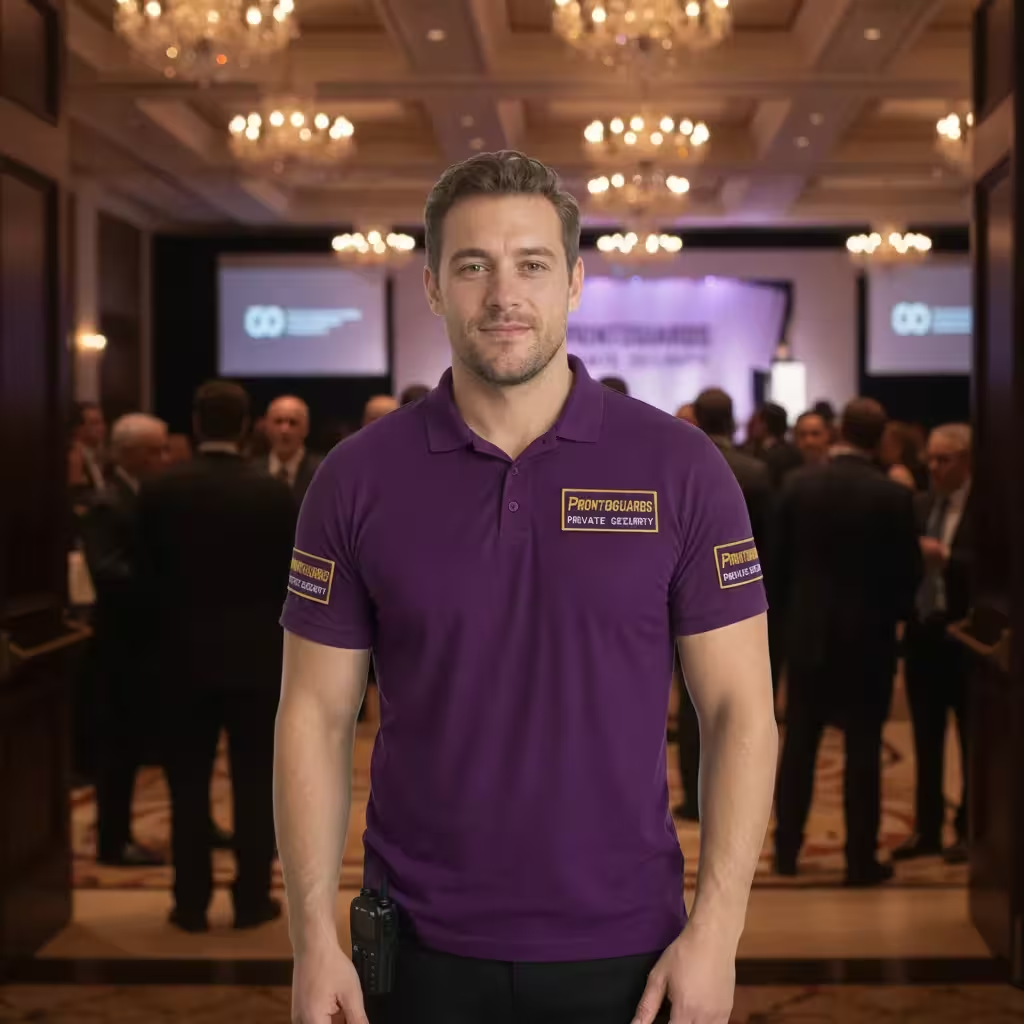
Need warehouse security security in California?

Book licensed officers online in about 60 seconds — exact price shown before you pay.

Order Guards Now →
Licensed CA security Call (747) 327-7380 24/7 dispatch